
Start privately, at your own pace
Use Novalyte's informational men's health assessment to organize concerns before talking with a licensed clinician. It does not diagnose low testosterone, ED, or any medical condition.
Why more men are privately searching testosterone, ED, fatigue, and men's health clinics
Many men begin researching men's health long before they book an appointment. Search histories often include phrases about low energy, reduced libido, weak erections after 40, unexplained belly fat, brain fog, poorer gym recovery, or questions about testosterone levels. That private research is understandable: sexual and hormonal concerns can feel sensitive, and men may want language and context before speaking with a clinician.
Skimming? If this topic feels relevant, a short informational assessment can help you organize questions for a licensed clinician. It takes a few minutes, covers TRT, and is not a diagnosis. Start the short assessment →
Online information can help with orientation—but it can also oversimplify. Fatigue, erectile dysfunction (ED), low libido, mood changes, and weight gain can overlap with sleep apnea, metabolic disease, medication effects, cardiovascular factors, thyroid disorders, depression or anxiety, stress, alcohol use, aging, and hormonal conditions. A clinic visit is one path among several; primary care, urology, endocrinology, and specialist men's health practices may all play a role depending on the situation.
Novalyte AI is a care-discovery and technology platform. It helps people learn, compare publicly listed clinic information, and prepare for conversations with licensed clinicians. Novalyte does not diagnose conditions, prescribe medications, operate a pharmacy, or guarantee treatment results. For a broader overview of how digital tools change access without replacing clinicians, see how healthcare technology is changing men's health access.
Privacy-conscious research does not replace clinical evaluation. Screenshots of lab ranges, influencer anecdotes, and clinic advertisements can create false certainty. A careful clinician will ask about timing of blood draws, recent illness, shift work, anabolic steroid or opioid exposure, and goals around fertility before recommending any therapy. Men comparing options should also ask how a clinic handles abnormal results that fall outside its usual protocol—for example newly discovered severe anemia, markedly elevated hematocrit, or symptoms suggesting sleep apnea.
If you are preparing for a visit, write down your top three concerns, a medication list, and questions about monitoring. That preparation improves the conversation whether you start with primary care, a men's health clinic, endocrinology, or urology. Novalyte's role is to help you organize that journey—not to decide treatment for you.
The symptoms men often search before looking for a clinic
Symptom searches are common entry points into men's health content. The items below are frequently researched together—but clustering does not prove a single cause. Use the list as a vocabulary aid for a clinical conversation, not as a self-checklist that confirms low testosterone.
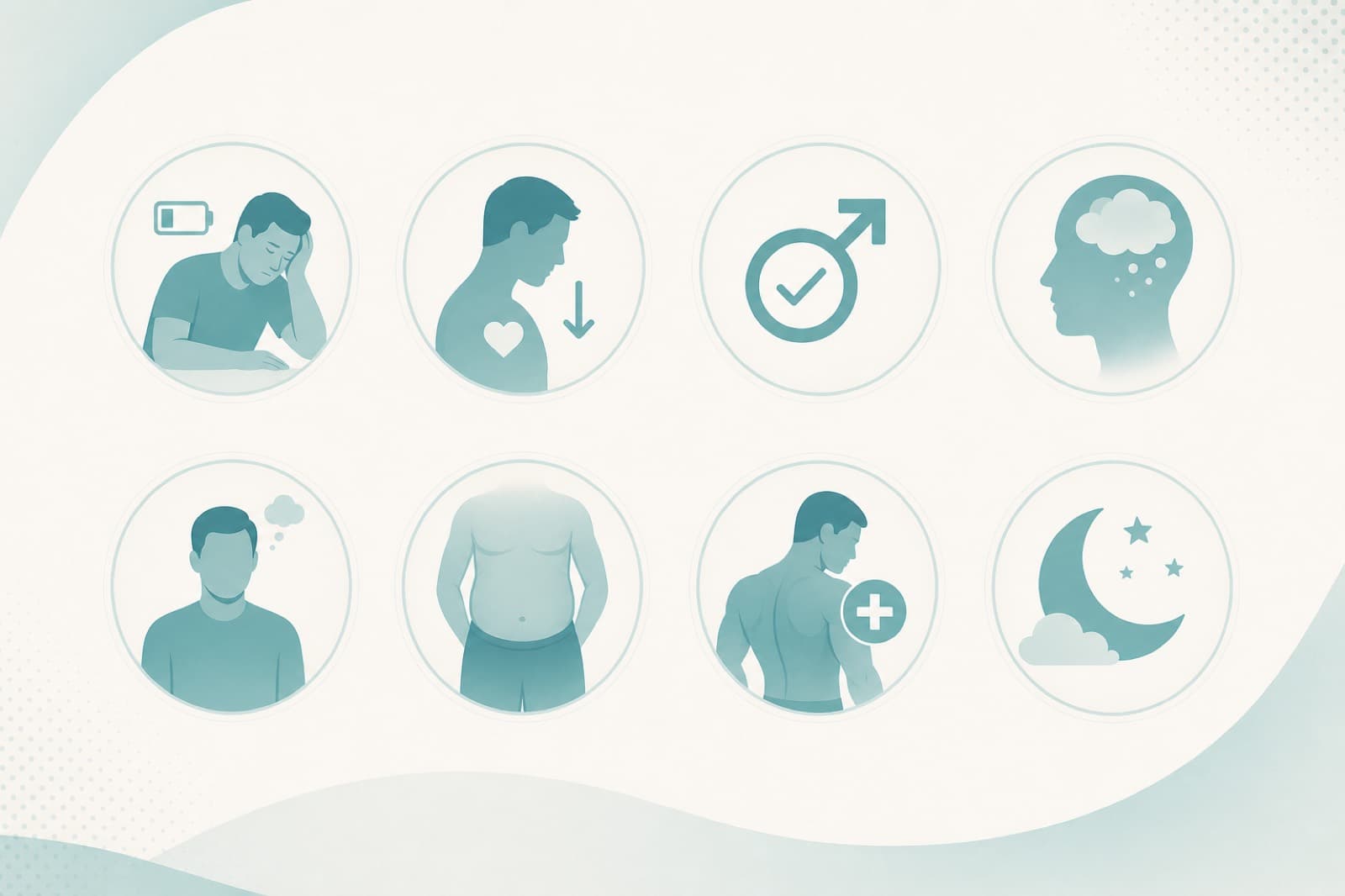
- Fatigue or low daytime energy that does not match sleep opportunity
- Low libido or reduced interest in sex
- Erectile difficulties, weaker erections, or inconsistent erectile quality—especially questions about weak erections after 40
- Brain fog, reduced focus, or mental fatigue
- Mood changes, irritability, or reduced motivation
- Increased belly fat or unexplained weight gain
- Reduced muscle mass or difficulty building or maintaining muscle
- Poorer workout recovery
- Sleep problems, snoring concerns, or unrefreshing sleep
- Questions about "normal testosterone levels in males" or whether to visit a men's health clinic near them
Could these symptoms indicate low testosterone?
Low testosterone (clinically discussed as hypogonadism when confirmed) can be associated with sexual symptoms, reduced energy, mood changes, and body-composition shifts in some men. Professional guidelines emphasize that diagnosis rests on compatible symptoms plus appropriately timed, repeated laboratory evaluation—and clinical judgment—not on a single afternoon blood draw or an online quiz.
The same symptoms can appear with obstructive sleep apnea, obesity and insulin resistance, type 2 diabetes, depression, chronic stress, opioid or glucocorticoid medications, pituitary disorders, thyroid disease, alcohol excess, and other conditions. Treating an underlying driver may change how a man feels—sometimes without testosterone therapy.
“Symptoms are signals, not a diagnosis.”
If you are comparing educational options, Novalyte's Testosterone Replacement Therapy overview explains evaluation pathways at a high level. That article, like this one, is educational and does not recommend TRT for every symptomatic reader.
Understanding testosterone testing
Laboratory evaluation is typically more nuanced than a single number labeled "low." Clinicians may consider total testosterone, free or calculated free testosterone when sex-hormone-binding globulin (SHBG) is altered (for example with obesity or aging), morning sampling when levels are often higher, and repeat testing on a separate day before committing to a long-term plan. Age, symptoms, medications, and coexisting illness all matter.

- 1Total testosterone — often the first screening measure; morning samples are commonly preferred.
- 2Repeat confirmation — guideline-oriented evaluation usually avoids diagnosing persistent deficiency from one isolated value.
- 3Free testosterone or SHBG-informed interpretation — especially when total levels are borderline or binding proteins are altered.
- 4Additional labs when indicated — such as LH, FSH, prolactin, or metabolic markers, based on clinical suspicion.
- 5Clinical context — symptoms, exam findings when performed, fertility goals, and reversible contributors.
Erectile dysfunction after 40
Erectile dysfunction becomes more common with age, but "common" is not the same as "inevitable" or "only hormonal." Vascular disease, diabetes and metabolic syndrome, medications (including some blood-pressure and psychiatric medicines), neurologic conditions, pelvic surgery or radiation, psychological factors, relationship stress, alcohol and tobacco use, and hormonal factors can each contribute—alone or together.

Because erectile difficulties can share risk factors with cardiovascular disease, some clinical frameworks treat new or progressive ED as a reason to review blood pressure, lipids, glycemic status, smoking, and overall risk—not only sexual performance. Men often ask whether they should see a urologist for ED, start with primary care, or use an online men's health clinic. The better question is usually: who can take a careful history, review medications, order or interpret appropriate testing, and escalate when needed?
For educational orientation only, you can also review Novalyte's informational erectile dysfunction assessment—it does not diagnose ED or authorize treatment.
Men's health clinic, primary-care clinician, endocrinologist, or urologist?
No single clinician type is universally "best." Access, symptoms, complexity, fertility goals, and local expertise matter. The comparison below is educational, not a ranking.
| Care setting | Common reasons men visit | Typical evaluation focus | When referral may occur | Telehealth notes | Useful questions |
|---|---|---|---|---|---|
| Primary care | Fatigue, weight change, metabolic screening, medication review, first ED discussion | Broad history, vitals, labs, preventive care | Complex endocrine, surgical, or specialized sexual-medicine needs | Often available; exam limits vary | What reversible causes should we rule out first? |
| Men's health clinic | Hormone concerns, sexual health, body-composition goals, coordinated men's services | Varies widely by clinic model and clinician credentials | When findings exceed clinic scope or require hospital-based care | Common in cash-pay and hybrid models | Who is the licensed clinician of record, and what monitoring is included? |
| Endocrinology | Confirmed or complex hypogonadism, pituitary issues, multi-hormone disorders | Hormone axes, specialized endocrine testing | From primary care or men's clinics for complexity | Varies by practice | Do my labs suggest primary vs secondary hypogonadism? |
| Urology / sexual medicine | ED, Peyronie's, prostate concerns, infertility evaluation pathways | Genitourinary and sexual-function evaluation | When surgical or advanced sexual-medicine options are considered | Some follow-ups may be remote; exams often in person | Could vascular, neurologic, or anatomic factors be involved? |
Understand which care category may fit your concerns
An informational assessment can help you organize symptoms and questions before you choose where to seek care. It is not a diagnosis and does not verify any clinic.
Related reading
Want a quicker read on next steps?
If this topic feels relevant, a short informational assessment can help you organize questions for a licensed clinician. It takes a few minutes, covers TRT, and is not a diagnosis.
TRT clinic versus online men's health clinic
Men comparing a local TRT clinic near them with an online men's health clinic often weigh convenience against examination, laboratory coordination, and continuity. Neither model is automatically superior. Quality depends on clinician licensure in your state, transparent prescribing policies, monitoring, and clear escalation pathways—not on whether the first visit happened on a video call.

| Factor | What to compare (either model) |
|---|---|
| Convenience | Scheduling speed, travel time, after-hours messaging |
| Physical examination | Whether and when an exam is required or offered |
| Laboratory coordination | Which labs, who interprets them, how results are shared |
| Follow-up | Visit frequency, who adjusts therapy, after-hours coverage |
| Provider credentials | Name, license, specialty, state medical-board verification |
| Continuity | Same clinician vs rotating coverage |
| Privacy | HIPAA practices, data handling, discreet shipping if used |
| Pricing transparency | Consult, labs, medication, supplies, membership fees |
| Emergency guidance | Clear instructions for urgent symptoms |
| Prescription policies | No guaranteed prescriptions; clinical criteria disclosed |
| Ongoing monitoring | Hematocrit, symptom review, and other guideline-aligned checks as indicated |
For operational and compliance context around remote care, see building a compliant telehealth men's health practice. Patients should still verify the specific clinicians and clinics they consider.
Search clinic profiles carefully
Directory listings may include publicly sourced or claimed profiles. Only clinics that completed Novalyte verification display a verified badge. Unclaimed and demo profiles are labeled accordingly.
What a men's health clinic evaluation may include
Services vary. A thoughtful evaluation may include health history, symptom timeline, medication and supplement review, vital signs, relevant laboratory testing, sleep and lifestyle screening, sexual-health history, fertility goals, and a follow-up plan. Some visits are telehealth-first; others emphasize in-person assessment. Ask what is included before you pay membership fees.
Ask whether the clinician of record is clearly identified, how after-hours concerns are handled, and whether therapy decisions are made only after confirmatory labs. Membership packages can be convenient, but opaque bundles make it hard to compare true TRT cost against a transparent fee-for-service model. Request a written list of what happens at week 0, month 1–3, and ongoing follow-up.
Men with fertility goals, complex endocrine histories, significant cardiovascular disease, or unexplained neurologic symptoms may need specialty pathways beyond a standard men's health intake. A trustworthy clinic will say when a case is outside its scope rather than stretching a protocol to retain a customer.
- Detailed history of energy, mood, sexual function, training, sleep, and weight change
- Medication, opioid, steroid, and supplement review
- Cardiometabolic risk factors and family history when relevant
- Laboratory testing selected for the clinical question—not a one-size panel sold as a diagnosis
- Discussion of fertility plans before any therapy that may suppress spermatogenesis
- Documented follow-up and monitoring expectations
TRT cost, insurance, and treatment formats
"How much does TRT cost?" has no single national answer. Pricing depends on consultation structure, laboratory frequency, medication and supplies, membership models, insurance benefits versus cash-pay, geography, and whether compounding or brand formulations are used. Be wary of advertisements that promise a fixed monthly price without disclosing labs, shipping, or follow-up fees.
Insurance coverage, when available, often depends on documented diagnosis codes, prior authorization rules, and preferred pharmacy networks. Cash-pay clinics may still require patients to pay separately for laboratory draws performed at third-party sites. Always clarify which fees are refundable if labs do not support therapy, and whether you can obtain your raw results for a second opinion.
Treatment formats should be explained in plain language: how often injections occur if used, how topical products should be applied to reduce transfer risk, and what procedural steps pellets require. Dosing is individualized and is not provided in this article. If a seller offers testosterone without a clinician relationship, that is not appropriate medical care.
- Initial consultation and any required examinations
- Baseline and follow-up laboratory testing
- Medication cost and administration supplies
- Follow-up visits or messaging fees
- Membership or program fees, if applicable
- Insurance cost-sharing versus cash-pay packaging
Clinician-directed approaches may include injections, topical gels or creams, patches, pellets, or other regulated formulations depending on availability and suitability. This article does not provide dosing instructions. Delivery methods differ in convenience, monitoring needs, transfer risk (for gels), and procedural requirements (for pellets). Shared decision-making with a licensed clinician is essential. See also the educational comparison notes in TRT: a complete guide for men.
Safety questions men commonly ask
Safety questions deserve careful, individualized answers—not internet reassurance or fear marketing. Topics men frequently raise include fertility, acne, hair changes, sleep apnea, blood-count monitoring, prostate-related monitoring, cardiovascular considerations, long-term follow-up, and what happens if therapy is stopped. Guidelines and product labeling discuss risks and monitoring; your personal risk profile may differ.
- Fertility — exogenous testosterone can suppress sperm production; men who want children should discuss alternatives and specialist referral before starting.
- Hematocrit / blood count — monitoring may be needed because therapy can raise red-cell mass in some patients.
- Prostate-related monitoring — age-appropriate screening and symptom review per clinician judgment and guidelines; this is not a substitute for urologic care when indicated.
- Sleep apnea — untreated apnea can worsen symptoms and overall risk; screening questions matter.
- Cardiovascular considerations — discuss personal history and risk factors; avoid clinics that dismiss monitoring.
- Stopping treatment — plans for dose changes or discontinuation should be clinician-directed.
Weight gain, belly fat, hormones, and metabolic health
Belly fat and low testosterone searches often appear together. Body composition, sleep, nutrition, insulin resistance, diabetes risk, stress, physical activity, medications, aging, and hormonal conditions can interact. Weight gain does not automatically prove low testosterone—and low testosterone does not automatically explain every change in waist size.
Some men explore medical weight-management options, including clinician-supervised GLP-1 medicines, as part of metabolic care. Those therapies have indications, contraindications, and side effects and must be prescribed by licensed clinicians. For educational context only, see GLP-1 medications and medical weight loss. A future Novalyte guide will focus specifically on men's metabolic health and weight-management clinics; that page is not published yet, so it is not linked here.
How to choose a men's health clinic

- 1Confirm appropriate clinician credentials and state licensure
- 2Ask for transparent pricing that includes labs and follow-up
- 3Understand the laboratory process and who interprets results
- 4Confirm ongoing monitoring expectations before starting therapy
- 5Review privacy practices and how health data is handled
- 6Ask about follow-up availability and escalation pathways
- 7Prefer evidence-aware communication over guaranteed outcomes
- 8Avoid clinics that promise prescriptions before evaluation
- 9Verify location, contact information, and telehealth service-area rules
- 10Remember: Novalyte "verified" status applies only after the clinic completes Novalyte's verification process
Your confidential next step
If you want a private way to organize concerns before contacting a clinic, use Novalyte's informational assessment. Answers help surface educational categories and directory filters. The tool will not declare that you have low testosterone, ED, or any diagnosis. Afterward, you can explore related education, treatment-category pages, and clinic listings—including claimed or verified profiles where available.
Take a private next step
Educational assessment → relevant guides → directory exploration. You stay in control of if and when you contact a clinician.
Related reading on Novalyte Journal: TRT overview, GLP-1 and medical weight loss, healthcare technology and men's health access, and the Journal hub.

Read next
Testosterone Replacement Therapy: A Complete Guide for Men
An educational overview of how testosterone replacement therapy is evaluated, what treatment involves, the monitoring that should accompany it, and the questions worth asking a licensed provider.
Frequently asked questions
Sources and references
Listed for general reference. Always consult the original sources for current clinical guidance; guidelines and safety communications are updated periodically.
- 11Bhasin S, et al. Testosterone Therapy in Men With Hypogonadism: An Endocrine Society Clinical Practice Guideline. J Clin Endocrinol Metab. Endocrine Society.
- 22American Urological Association. Evaluation and Management of Testosterone Deficiency (guideline resources).
- 33American Urological Association. Erectile Dysfunction guideline resources.
- 44MedlinePlus. Testosterone. U.S. National Library of Medicine.
- 55National Institute of Diabetes and Digestive and Kidney Diseases (NIDDK). Sexual and Urologic Problems of Diabetes.
- 66U.S. Food and Drug Administration. Testosterone Information (safety communications and labeling resources).
- 77Centers for Disease Control and Prevention. Heart Disease risk factors (cardiometabolic context for men's health discussions).
Novalyte editorial contributors write educational men's-health explainers for patients researching care options. Articles are reviewed under Novalyte's editorial workflow and are not a substitute for clinical advice.
Get the Novalyte Journal in your inbox
Educational articles on men's health treatments, clinic operations, and workforce trends. No spam, unsubscribe anytime.
Want a quicker read on next steps?
If this topic feels relevant, a short informational assessment can help you organize questions for a licensed clinician. It takes a few minutes, covers TRT, and is not a diagnosis.
Explore testosterone-replacement-therapy clinics
Browse the Novalyte directory of verified men's health clinics by location, specialty, and telehealth availability.