
For many men, seeking healthcare has never been straightforward. Work schedules, geographic limitations, privacy concerns, and the perception that asking for help is unnecessary all contribute to delayed care. Men in the United States are less likely than women to visit a physician for preventive care and more likely to postpone treatment until symptoms become urgent [1]. Digital healthcare technology is beginning to address some of these barriers, offering tools that let men research symptoms, compare clinics, schedule consultations, and coordinate laboratory testing from a smartphone or laptop.
A telehealth visit eliminates the commute, the waiting room, and in some cases the discomfort of discussing sensitive health topics in person. Digital platforms allow patients to complete intake forms in advance, receive appointment reminders, communicate through secure messaging, and access test results through patient portals. For men researching testosterone evaluation, erectile-dysfunction care, medical weight management, or preventive screening, these tools can make the difference between taking action and continuing to wait. Start with our educational guides on testosterone replacement therapy and GLP-1 medications and medical weight loss, or take a short informational assessment if you want help organizing questions before you talk to a clinician.
However, convenience alone does not establish clinical quality. A polished application does not verify that the clinician is licensed in your state, that the platform protects your health data under HIPAA, or that follow-up care will be available if your situation changes. This article explains how healthcare technology for men's health actually works, where it helps, where it falls short, and what every patient should verify before sharing personal health information or paying for an online consultation.
Skimming? If this topic feels relevant, a short informational assessment can help you organize questions for a licensed clinician. It takes a few minutes, covers TRT, and is not a diagnosis. Start the short assessment →
Key Takeaways
- Healthcare technology can reduce barriers to accessing men's health services, but it does not replace clinical judgment or in-person care when medically necessary.
- A legitimate online men's health clinic will clearly identify its licensed clinicians, state licensure details, and privacy protections before you provide any health information.
- Telehealth eligibility varies by state; the clinician you consult must hold an active license in the state where you are located at the time of the visit.
- An online questionnaire or symptom quiz is not a diagnosis. Laboratory testing and professional clinical evaluation remain essential for accurate assessment of hormonal, metabolic, and cardiovascular health.
- Pricing transparency is critical. Some clinics advertise low consultation fees but bill laboratory work, medication, shipping, and follow-up visits separately.
- Wearable devices and remote monitoring can provide useful data, but the information they generate requires professional interpretation to be clinically meaningful.
- Patients should understand a clinic's escalation and emergency procedures before enrolling, particularly for telehealth-only services.
- Continuity of care, including repeat testing and structured follow-up, is an important indicator of a responsible digital health practice.
Why Men May Delay Healthcare
Research from the CDC has consistently shown that men are less likely than women to have had contact with a physician in the previous year and more likely to report delaying care due to cost, inconvenience, or perceived lack of need [1]. Work demands and rigid schedules make it difficult for many men to attend daytime appointments. In rural or underserved areas, the nearest specialist may be hours away. For conditions involving sexual health, hormonal function, or mental wellness, stigma and embarrassment create additional friction.
Some men report uncertainty about when to seek care. Symptoms such as fatigue, reduced libido, or mood changes can feel vague. Others express frustration with the traditional care experience: long wait times, brief appointments, and fragmented communication between providers. Digital healthcare tools have found a meaningful role in addressing these practical barriers for men who are ready to act.
What Healthcare Technology Actually Means
Healthcare technology covers software, platforms, devices, and systems that support healthcare delivery and coordination. Understanding the distinctions between online entities is essential.
A healthcare technology platform, such as Novalyte AI, helps users discover, compare, and connect with independent clinics and licensed professionals. It does not diagnose, prescribe, or treat. A licensed clinic employs clinicians who evaluate patients and develop care plans. A laboratory processes biological samples for clinical interpretation. A pharmacy dispenses medications based on prescriptions. A patient portal is a secure online interface for viewing records, messaging providers, and managing appointments.
Software can make scheduling easier, intake faster, and communication more organized. But it cannot independently diagnose, prescribe, or treat. A digital health platform is not the same as a medical provider, and understanding that distinction is essential.
The Modern Digital Men's Healthcare Journey
The patient journey in digital men's healthcare unfolds through stages, each supported by different technologies. While not every patient follows every step, this framework illustrates how technology connects the stages of care.
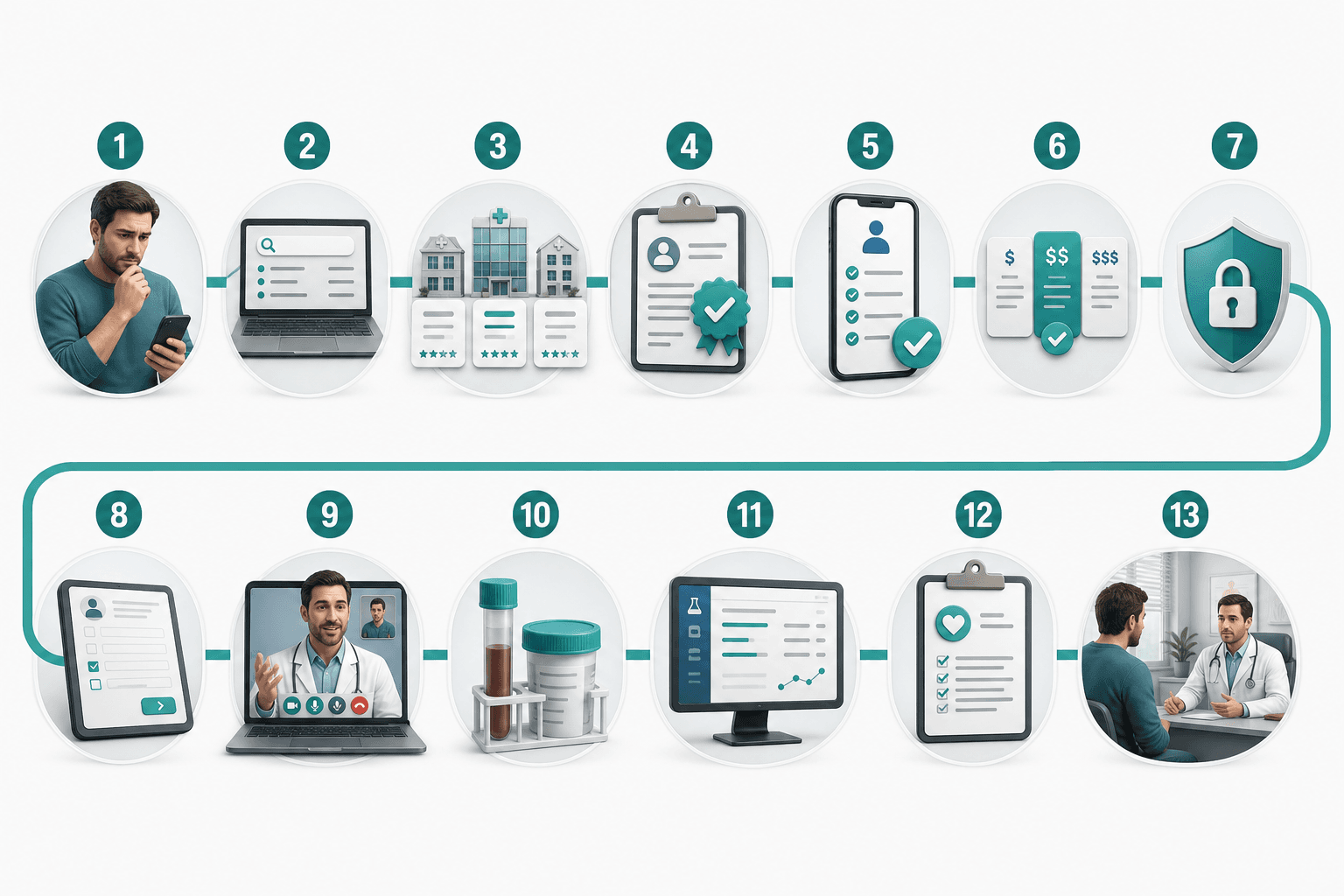
- 1Recognizing a health concern: The patient notices symptoms or decides to pursue preventive care. Health apps or educational content may prompt this step.
- 2Researching care categories: Digital platforms and educational articles help define what kind of provider might be appropriate.
- 3Comparing clinics: Using a directory or comparison tool, the patient evaluates options based on credentials, pricing, and telehealth availability.
- 4Verifying provider credentials: The patient confirms the clinic and clinicians are properly licensed and credentials are verifiable.
- 5Checking telehealth eligibility: The patient confirms the clinic offers telehealth in their state and their concern is appropriate for a virtual visit.
- 6Reviewing pricing: The patient examines the full cost structure, including consultation fees, lab charges, medication, and shipping.
- 7Completing secure intake: Through a HIPAA-compliant process, the patient provides medical history, medications, symptoms, and consent.
- 8Attending a consultation: The patient meets with a licensed clinician via video, phone, or in person to discuss concerns and next steps.
- 9Coordinating laboratory testing: Lab orders are fulfilled at local facilities or, where appropriate, through at-home collection kits.
- 10Receiving professional interpretation: The clinician reviews results in clinical context and discusses findings and potential next steps.
- 11Following a care plan: The patient follows the agreed plan, which may include medication, lifestyle changes, or referrals.
- 12Completing follow-up monitoring: Through portals and secure messaging, the patient and clinician track progress and adjust the plan.
- 13Escalating to in-person care: If symptoms change or the case exceeds telehealth scope, the patient is referred to an in-person provider.
How Technology Is Changing Men's Healthcare Access

Telehealth Consultations
Telehealth allows patients to consult with licensed clinicians through video, phone, or secure messaging. For men's health, this has expanded access to evaluations for hormonal health, erectile dysfunction, weight management, hair loss, and preventive care. The clinician must hold an active license in the state where the patient is physically located at the time of the consultation [2].
Identity verification is standard in legitimate telehealth. Patients typically provide a photo ID before their first visit. Informed consent is obtained electronically. Not all conditions are appropriate for virtual evaluation. Acute symptoms, cardiovascular risk, or conditions requiring physical examination need in-person care. Emergency symptoms require immediate local care.
Online Appointment Scheduling
Digital scheduling systems allow patients to view available times, select consultation types, and receive automated confirmations and reminders. For men balancing demanding schedules, the ability to book evening or weekend telehealth appointments without calling during business hours removes a practical obstacle.

Digital Patient Intake
Before a consultation, many clinics ask patients to complete digital intake forms covering medical history, medications, allergies, and symptoms. This allows clinicians to use consultation time effectively. However, intake forms are not diagnostic tools. They collect information for clinical interpretation, not automated diagnosis.
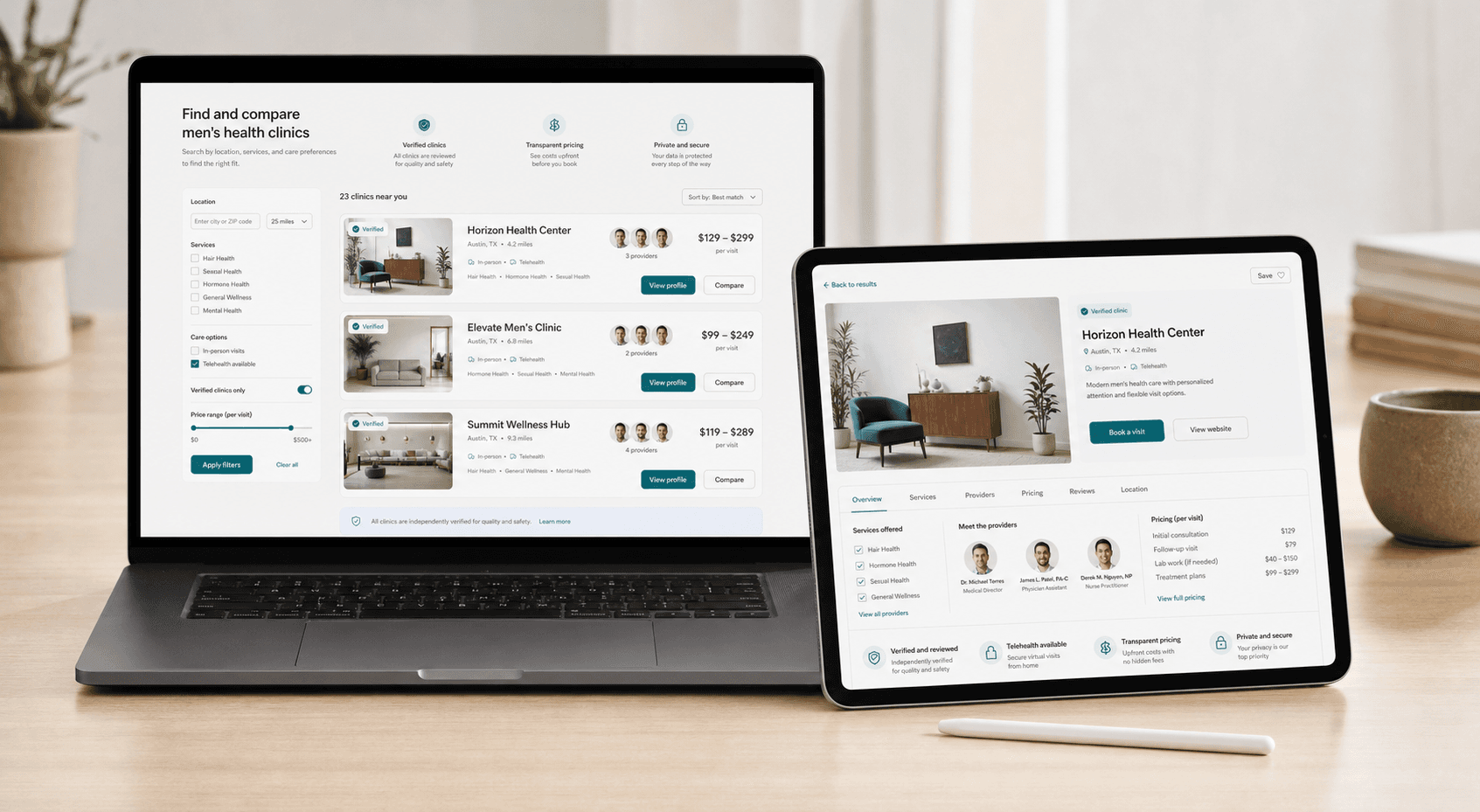
Clinic Discovery and Comparison
Healthcare technology platforms and clinic directories allow patients to compare options based on location, services, provider credentials, pricing, and telehealth availability. Patients should verify that information is current and that any verification badges come from recognized accreditation bodies, not the platform itself.
Laboratory Coordination
Many men's health evaluations require laboratory testing, including blood panels for testosterone and metabolic markers. Digital platforms coordinate this by issuing lab orders fulfilled at local facilities. At-home kits are available where legally and clinically appropriate. Clinicians must ensure sample integrity and interpret results in clinical context [3].
Patients should understand which lab processes samples, whether it is certified, and how results are delivered. Abnormal results may require repeat testing or referral.
Secure Patient Communication
Patient portals and secure messaging allow patients to communicate with their care team and request refills. These systems should use encryption and comply with HIPAA [4]. Ordinary email and text messaging are not secure for sensitive health information.

Remote Monitoring
Wearable devices and connected tools can track blood pressure, weight, glucose, sleep, heart rate, and activity levels. This data can support ongoing care decisions. However, wearables have known accuracy limitations. Their data is most useful when interpreted by a clinician who can account for device limitations and patient context. Remote monitoring data without professional interpretation may be misleading.
Digital Follow-Up and Continuity of Care
Continuity of care is a recognized component of quality healthcare. Digital tools support this through repeat appointments, lab testing, progress monitoring, and specialist referrals. A clinic with clear follow-up protocols, accessible records, and structured escalation to in-person care demonstrates responsible management.
Men's Health Use Cases
Testosterone and Hormone-Health Evaluation
Related reading
Want a quicker read on next steps?
If this topic feels relevant, a short informational assessment can help you organize questions for a licensed clinician. It takes a few minutes, covers TRT, and is not a diagnosis.
Symptoms commonly associated with low testosterone, including fatigue, reduced libido, and mood changes, have multiple causes. Thyroid dysfunction, depression, sleep disorders, and medication side effects may produce similar presentations. A thorough clinical evaluation with laboratory testing is necessary to determine whether testosterone levels are below normal range [5]. Testing typically requires blood draws, ideally in the morning when levels peak. A single low result may warrant repeat testing. Treatment decisions involve careful consideration of contraindications, including prostate health, cardiovascular risk, and fertility.
Weight-Management Care
Medical weight management involves evaluating metabolic health, understanding contributing factors, and developing a treatment plan that may include behavioral support, medication, or both. Medication, when prescribed, should follow a comprehensive evaluation by a licensed clinician [6]. Programs that offer medication primarily, without thorough evaluation or structured follow-up, may not serve the patient's long-term health interests.
Erectile-Dysfunction Care
Erectile dysfunction has potential vascular, hormonal, psychological, or medication-related contributing factors. The privacy benefits of telehealth are significant, as many men find it easier to discuss these concerns remotely. However, proper evaluation remains important. Cardiovascular health should be assessed, as erectile dysfunction can be an early indicator of underlying vascular disease [7]. Patients should be aware of medication safety considerations, including interactions with nitrates.
Preventive Healthcare
Preventive care includes blood-pressure monitoring, cholesterol and diabetes screening, cancer screening based on age and risk, vaccinations, sleep assessment, mental health evaluation, and counseling on tobacco, alcohol, nutrition, and physical activity. Digital tools support this by sending screening reminders, tracking metrics over time, and facilitating access to educational resources [8].
Hair-Loss Care
Hair loss in men has multiple possible causes, including androgenetic alopecia, nutritional deficiencies, and thyroid conditions. Online consultations can be a convenient starting point. However, patients should be cautious of clinics that present unrealistic before-and-after claims or guarantee outcomes. Medications carry potential side effects, and the decision to use them should involve a proper medical history review [9].
Sleep and Recovery
Sleep health connects to cardiometabolic health, hormonal balance, and cognitive function. Digital tools include sleep questionnaires, wearable trackers, home sleep-testing devices, and platforms connecting patients with sleep specialists. Consumer wearables provide useful trend data but are not diagnostic. Suspected sleep disorders require professional evaluation, which may involve laboratory sleep studies [10].
Fertility and Reproductive Health
Fertility evaluation typically involves medical history review, semen analysis, hormonal testing, and assessment of lifestyle factors. Patients considering fertility evaluation should discuss how certain hormone treatments, including testosterone therapy, may affect fertility, and understand available referral pathways.
Healthy Aging and Longevity Services
Evidence-based healthy-aging care focuses on preventive health, risk-factor management, fitness, sleep, nutrition, and cardiometabolic health. Patients should be aware that many commercial longevity panels have unclear clinical value. Unsupported anti-aging claims and expensive testing packages with uncertain benefits should be approached with skepticism [11].
Benefits and Limitations of Digital Men's Healthcare
| Technology | Potential Benefit | Key Limitation | Verify This |
|---|---|---|---|
| Telehealth | Convenient access to licensed clinicians | Not appropriate for all conditions; state licensure required | Clinician license in your state |
| Digital Intake | Streamlines information collection | Not a diagnostic tool | HIPAA compliance |
| Online Scheduling | Reduces booking friction | Availability may be limited | Cancellation policies |
| Clinic Directories | Enables structured comparison | Information may be outdated | Data currency; accreditation sources |
| Remote Lab Coordination | Convenient local sample collection | Lab quality and at-home kit limitations vary | Lab certification (CLIA) |
| Patient Portals | Centralized records and messaging | Not all are equally secure | Encryption standards |
| Secure Messaging | Facilitates communication between visits | Not for urgent concerns | Response-time expectations |
| Wearable Monitoring | Generates useful trend data | Accuracy varies without context | Clinical interpretation plan |
| Remote Patient Monitoring | Supports chronic-condition management | Requires clinician oversight | Supervision model |
| Automated Reminders | Improves appointment adherence | May reduce personal contact | Balance of automation and human interaction |
| AI-Assisted Navigation | Helps find appropriate care categories | Cannot replace clinical judgment | Human oversight exists |
What to Look for Before Booking an Online Men's Health Consultation
The following checklist identifies the key indicators of a responsible digital men's health practice. Confirm each item before sharing personal health information or making a payment.
- Clearly identified licensed clinicians with verifiable credentials and state licensure
- Transparent clinic ownership and verifiable business contact information
- Published privacy policy compliant with HIPAA requirements
- Secure patient portal with encrypted communication
- Informed-consent process completed before treatment
- Clear, itemized pricing explaining what is and is not included
- Laboratory process explained, including lab certification and sample handling
- Follow-up model described, including frequency and modalities
- Emergency limitations stated, with guidance on when to seek local care
- No guaranteed diagnoses, prescriptions, or quiz-only diagnoses
- Cancellation, refund, and recurring-membership terms provided in writing
- Referral pathways to in-person specialists when needed
- Medical-record access and transfer process explained
- Adverse-event reporting process in place
- Secure payment processing with standard encryption
Red Flags to Avoid
The following warning signs indicate a service may not be operating responsibly. Each represents a risk to patient safety, privacy, or financial wellbeing.
- Guaranteed diagnosis: No clinician can guarantee a diagnosis before evaluation.
- Guaranteed prescription: Prescribing requires individual clinical evaluation.
- Medication without evaluation: Prescriptions without medical history and lab testing are unsafe.
- Hidden clinician identity: If you cannot verify who evaluates you, the service cannot be vetted.
- Missing licensure information: Legitimate clinics display licensure details and authorized states.
- No verifiable contact information: No physical address or business registration is a warning sign.
- No privacy policy: Health information collection requires a published privacy policy.
- No secure portal: Unencrypted forms do not protect your data.
- Vague billing: Hidden fees and unclear subscriptions suggest irresponsible practices.
- Unsupported health claims: Anti-aging or guaranteed-result claims are not evidence-based.
- Testimonials as proof: Marketing testimonials are not clinical evidence.
- Pressure to purchase: Urgency tactics are inappropriate in healthcare.
- No follow-up process: Clinics without follow-up or adverse-event reporting are not responsible.
- No escalation explanation: Telehealth services must explain when in-person care is needed.
- Unsecured data requests: Submitting health data through unencrypted channels risks privacy.
How to Compare Men's Health Clinics
When evaluating clinics, use a structured approach. The following framework covers the key factors, signals, and warning signs.
| Factor | Questions to Ask | Why It Matters | Positive Signal | Warning Sign |
|---|---|---|---|---|
| Provider Credentials | Who evaluates me? What are their qualifications? | Ensures clinical expertise | MD, NP, or PA credentials shown | No provider info available |
| State Licensure | Is the provider licensed in my state? | Telehealth requires state licensure | License number and state provided | Vague national licensure claims |
| Clinic Verification | Is the clinic registered and in good standing? | Confirms legitimacy | State registration linked | No verifiable business entity |
| Telehealth Coverage | Which states do you serve? | Determines if you can be seen | State-by-state availability map | No state restrictions noted |
| Laboratory Process | Where are labs done? Which lab? | Lab quality affects accuracy | CLIA-certified lab named | Lab ownership unclear |
| Consultation Price | What is included? | Prevents surprise charges | Itemized pricing published | Exclusions hidden |
| Medication Costs | Are medications billed separately? | Total cost may exceed advertised price | Medication pricing transparent | No cost information |
| Insurance | Do you accept insurance or HSA/FSA? | Affects out-of-pocket cost | Insurance verification tool | Self-pay only, no alternatives |
| Follow-Up | How are follow-ups handled? | Continuity affects outcomes | Scheduled follow-ups included | No follow-up described |
| Privacy | How is my data protected? | Health data needs strong protection | HIPAA compliance stated | No privacy policy |
| Emergency | What happens with urgent symptoms? | Telehealth cannot handle emergencies | Clear escalation to 911/ER | No emergency guidance |
Questions to Ask Before Scheduling a Consultation
Before booking, prepare to ask direct questions. A reputable clinic should answer each of these clearly.
- Who will evaluate me, and what are their credentials and licensure details?
- Is the provider licensed in the state where I am currently located?
- How can I independently verify the provider's credentials through a state medical board?
- What information is required before the consultation, and how is it collected?
- Are laboratory tests required, and what specific tests will be ordered?
- Where will tests be performed, and which laboratory processes the samples?
- Who interprets my results, and how will findings be communicated?
- Are repeat tests ever required, and under what circumstances?
- How are follow-up visits structured, and how often do they occur?
- What happens when my condition requires in-person care or specialist referral?
- What is included in the consultation price, and what is billed separately?
- Are laboratory tests, medications, and shipping billed separately?
- Is there a recurring membership or subscription, and what are its terms?
- How do I cancel a membership, and what is the cancellation policy?
- How is my health information protected, and does the platform comply with HIPAA?
- Can I download or transfer my medical records?
- How are urgent or concerning symptoms handled between scheduled visits?
- What happens when my assigned provider is unavailable?
- Will my health information be shared with third parties?
- How do I report medication side effects or adverse reactions?
- Does the clinic coordinate with my existing primary-care provider?
- What is the refund or cancellation policy?
- How long does it typically take to receive a response through the portal?
- What adverse-event reporting process is in place?
- Are there clear escalation procedures for emergencies?
Use this list as a reference when you compare men's health clinics. Review clinic profiles on Novalyte AI to find the information you need before scheduling.
How Novalyte AI Fits Into the Ecosystem
Novalyte AI is a healthcare technology platform that helps people discover clinics, compare care options, explore educational resources, and connect with independent clinics and licensed professionals. Novalyte AI does not diagnose, prescribe, provide medical advice, determine treatment eligibility, own listed clinics, guarantee clinical quality, guarantee licensure, guarantee availability, or guarantee outcomes.
The platform serves as a discovery and comparison layer. Patients are encouraged to verify all provider credentials, review privacy practices, and confirm pricing directly with the clinic before proceeding.
Conclusion
Healthcare technology is reshaping how men find, access, and manage care. Telehealth, digital clinic discovery, online scheduling, secure messaging, and remote monitoring have made it easier for men to take the first step toward addressing health concerns that might otherwise go unaddressed. For informed, cautious patients, these tools offer genuine value.
The key is to use technology as a tool, not a substitute for clinical judgment. Verify provider credentials and state licensure. Review privacy practices. Understand the full cost structure. Ask about follow-up care, emergency procedures, and referral pathways. Be wary of services that promise guaranteed outcomes, hide provider information, or pressure you into immediate decisions.
The most responsible digital health practices combine technology with licensed clinical care, structured follow-up, and clear communication. Whether you are researching testosterone evaluation, weight management, erectile-dysfunction care, or preventive screening, the tools are available. The responsibility to use them wisely is yours.

Read next
Building a Compliant Telehealth Men's Health Practice
Operational and structural considerations for delivering men's health care across state lines — licensure, medical direction, clinical workflows, prescribing rules, and privacy obligations.
Frequently asked questions
Sources and references
Listed for general reference. Always consult the original sources for current clinical guidance; guidelines and safety communications are updated periodically.
- 1Men's use of health services and preventive careU.S. Centers for Disease Control and Prevention, National Center for Health Statistics (for general reference)
- 2Telemedicine policies and state medical licensureFederation of State Medical Boards (for general reference)
- 3Clinical Laboratory Improvement Amendments (CLIA)Centers for Medicare & Medicaid Services (for general reference)
- 4HIPAA privacy and security guidanceU.S. Department of Health and Human Services (for general reference)
- 5Testosterone therapy clinical practice guidelineEndocrine Society (for general reference)
- 6Pharmacological interventions for adults with obesityAmerican Gastroenterological Association (for general reference)
- 7Erectile Dysfunction GuidelineAmerican Urological Association (for general reference)
- 8Preventive services recommendationsU.S. Preventive Services Task Force (for general reference)
- 9Hair loss diagnosis and treatment resourcesAmerican Academy of Dermatology (for general reference)
- 10Clinical guidance for sleep disordersAmerican Academy of Sleep Medicine (for general reference)
- 11Healthy aging and preventive health resourcesNational Institute on Aging (for general reference)
The Novalyte Editorial Team publishes practical, evidence-aware educational resources to help patients and healthcare organizations understand men's health access, technology, and care navigation.
Get the Novalyte Journal in your inbox
Educational articles on men's health treatments, clinic operations, and workforce trends. No spam, unsubscribe anytime.
Want a quicker read on next steps?
If this topic feels relevant, a short informational assessment can help you organize questions for a licensed clinician. It takes a few minutes, covers TRT, and is not a diagnosis.
Find a verified men's health clinic
Browse the Novalyte directory of verified men's health clinics by location, specialty, and telehealth availability.